
Its Quitting Time
Or at least thats what companies want you to think it is.

Welcome back everyone.
I hope everyone’s start to the new year has been enjoyable and productive.
But if it hasn’t and you have struggled with a new habit or behaviour you want to introduce into your life, then you are not alone and I am here to support you.
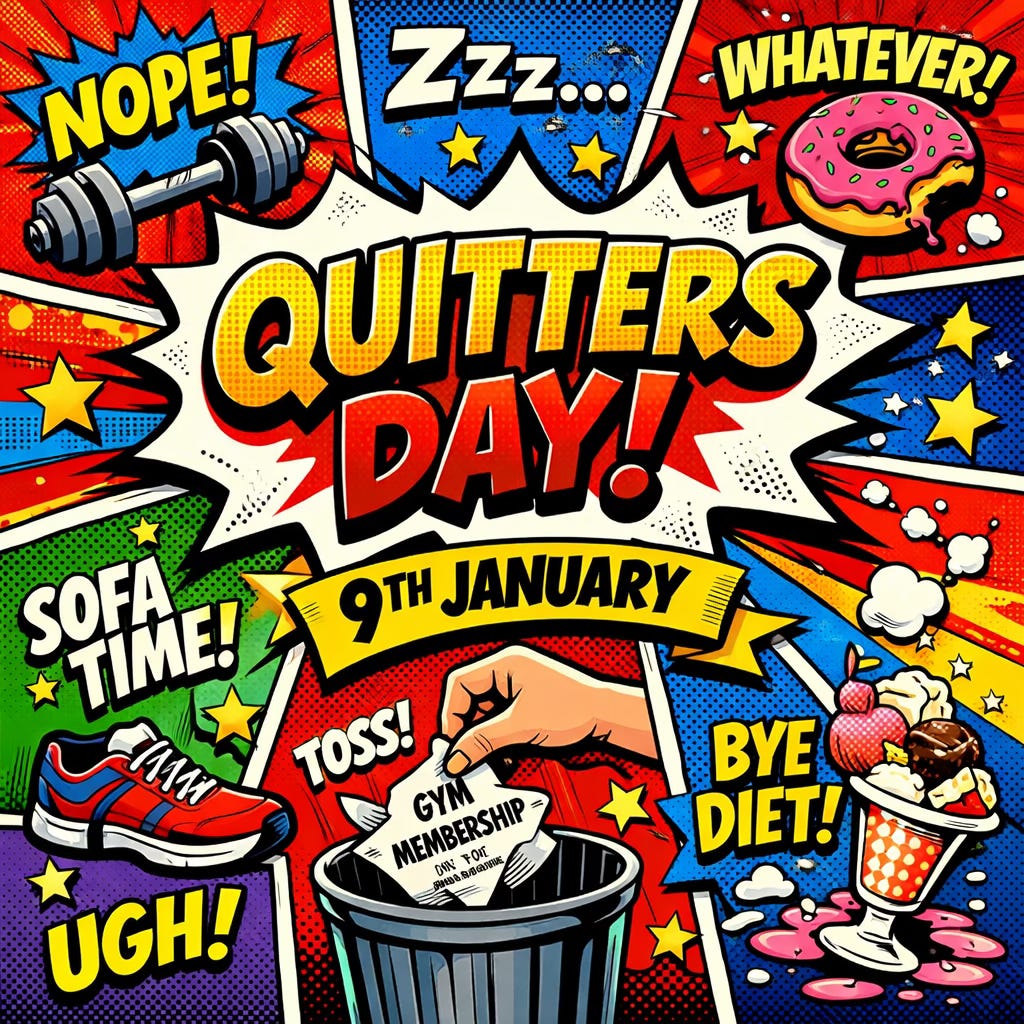
The second Friday of January has become known as Quitters Day. A day when people quit their resolutions, new behaviours or healthy habits.
Most people are familiar with the influx of people who join gyms in the new year - people determined to become fitter, healthier, lose weight and look like a comic book character.
Most people are also familiar with the times when we break those new habits.
You have been doing it everyday, without fail. At first it felt incredible and you know it is going to make a difference to your life - then you might miss a day because something came up - “thats ok” you say to yourself, “back on it tomorrow”.
But then tomorrow comes around and you miss again.
“Tomorrow definitely!”
You do it, but you also realise that you feel tired - fatigued or haven’t lost weight or your bum and biceps havent grown how you want them too.
So your motivation dwindles, the weekend comes around and you stop - you return to your old habits because they feel comfortable - homely - they are more in line with how you see yourself.
And that might be the crux of the issue - people only view outcomes - they don’t tend to re-evaluate who they are and who they want to become.
A change of habit is more likely to stick if you focus on how you identify with yourself, not focus on a specific, possibly unrealistic outcome in the timeframe you have arbitrarily set.
Quitters day
Was first identified in 2009 by Dr John Norcross; a behavioural pyschologist, and has been backed up by data from gyms and other places where attendance drops off.
This day is like a perfect storm of occurrences that attribute to the decisions people make.
Their motivation has waned, work pressure has ramped up, results haven’t appeared yet and the original goal was probably too big to achieve in the time set.
There will be some form of comparison going on as well.
“Jane is amazing - she turns up everyday ready to go - thats not me, I can’t be like Jane!”
This is known as a limiting belief; where your own beliefs about yourself and your abilities are holding you back from making the change you want to make.
Something Wicked This Way Comes
And then there is something darker occurring that is also affecting your ability to commit and plan for the new habit.
Tech companies are leveraging your insecurities around your own ability to be successful without using their devices or systems.
I noticed an advert by Apple for their Watch, highlighting Quitters Day and showing someone out-running their bed - all because their watch has motivated them to keep going.
Now - there is some truth to this but not in a way you might be thinking.
Having someone or thing hold you accountable can make a difference to you maintaining your habit and reaching your goals. I use this all the time and offer it to my clients.
But you don’t need a machine to do this - your partner, friends and family can help keep you accountable if you set them to task and know how potentially you could self-sabotage your journey.
These companies aren’t really interested in making you go for a run - they just want you invested in their product, knowing that you will spend money with them as they build trust and each year may even upgrade to the newest version of that product.
They position their product in your life to make it seem essential to you - something that you could not possibly live without.
I have fallen for this - I have an Apple Watch and am heavily invested in the Apple eco system. I bought the watch to help me curb my phone use - knowing that I wouldn’t scroll on there like I would a phone. It did work but then I noticed distractions and notifications directing me to lose my focus and workflow due to the buzz on my wrist.
I was addicted to checking my health data - what is my heart rate today, did I sleep well, how many steps have I taken today?
But here is the issue - I could find that out myself, without the need for a device.
I can measure my heart rate first thing in the morning to identify resting heart rate. I can subjectively rate my sleep quality based on how I am feeling.
And steps, yes I wont know exactly how many steps I have taken but I know for sure if I have been sat on my arse all day.
In the end I was mainly using it as an alarm clock and sleep tracker. But quickly realised that I didn’t need that either - plus the sleep tracker would tell me I had a great nights sleep but that wouldn’t track with how I was feeling.
And my alarm - well my Casio watch has an alarm and a setting that means the alarm goes off every 5 mins for the next half an hour.
I realised I didn’t need the Apple Watch.
The Analog Answer
To start, let me tell you something you may or may not be ready to hear!
You can, absolutely be just like Jane or better!
You can be the person people look at and say that you have your shit together.
You can be the person you know you aspire to be.
It will just take some time, effort and robust systems in place to ensure that you can become the version of you, you visualise in your mind.
Firstly - you must be prepared for some pain and discomfort because change doesn’t happen without this.
There will be times when you are unable to follow the system you have created due to circumstance beyond your control
There will be moments when you revert back to old habits - but these don’t have to mean you have reverted back forever.
This is perfectly natural and is recognised in any behaviour change model. Relapse happens, but the key is recognising when it does and taking action.
James Clear in his book Atomic Habits has a clear rule
‘You may miss a day - never miss two days”
He talks about reinforcing the habit through repetition - making it feel natural to you to perform. By doing this you are reinforcing the behaviour as well as reinforcing your self-identity to the person you aspire to be.
Going back to the gym analogy - people tend to focus on the outcome.
I want to lose 2 stone
I want to run a marathon
I want to look like Christian Bale or Jennifer Lopez (the JLo wish I have had with gym clients in the past) .
But the key is not wanting this set outcome - but to focus on the identity you want to encourage and create.
“I am a person who goes to bed at 10pm and wakes up at 6am each day because I know sleep is important to me and helps my day go well”
“I am a person who exercises 3 times a week so that I am healthier, stronger and happier with how I feel”
“I am a person who only scrolls social media for half an hour in the evening to help me focus on what’s important to me in my work and my personal life.”
You may notice that all of these examples are around creating an identity and also have specifics included in them. Time to sleep, times a week to exercise, set amount of phone use.
And you can monitor this and hold yourself accountable in an analog way. You don’t need to rely on technology to tell you what or how to do something.
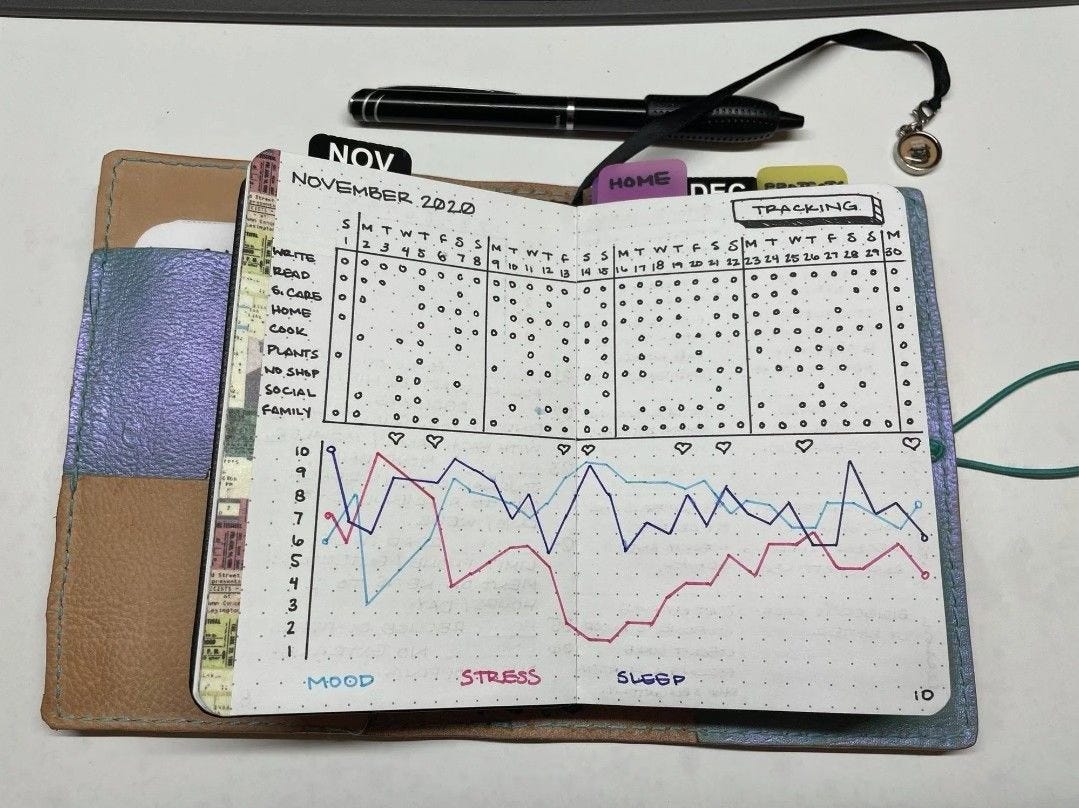
I use habit trackers to help ensure I keep myself accountable to who I am and the new skills I want to develop.
I record my sleep time, sleep quality, mental health and also a pain scale for my back issues.
I also track my habits with my 3 MIHs (most important habits) tracked first. Exercise, Meditation and Substack.
I then have lesser habits such as following the 80% rule for eating, practicing guitar and piano (something I notice I haven’t done this year yet…DOH!) Journaling, writing, sketching and then any extra exercise I am able to do and the last is reducing my phone use.
You can create whatever tracker or accountability system you want but you must also plan for the times you may struggle and what you are going to do in those situations.
For example - you might be wanting to stop drinking in January or forever.
What are you going to do when someone invites you out or offers you a drink? Are you going to refuse to go out completely - I know plenty of people who have done that.
Or are you going to go out but only drink soft drinks. Do you think at some point you will say “go on, one can’t hurt me!” - what is your plan for when you get the urge to say this or after your drunken friends are insisting you have an alcoholic drink saying “you can’t be enjoying yourself without a vodka and coke!”?
The use of language is important in these habit changing circumstances and helps reinforce the identity you want to create.
“I don’t drink” or even to a lesser degree “I don’t drink during January!”
Using more certain language helps your consciousness identify your new identity.
When it’s vague it leaves wriggle room for temptation to creep in and generally, as humans, we don’t do well with uncertainty and fall back onto previous behaviours more easily.
Some Advice from a Coach
In my personal and professional experience it is my belief, that is backed up by behaviour change science, to make any change it has to start off small and manageable.
You can then broaden and build the habit over time. The habit compounds the longer you are making improvements to yourself - 1% every day is a common thread posted by productivity experts.
If the behaviour is too big and grandiose - your mind can’t cope with the situation and will ultimately lead to failure.
Break your chosen habit down to its smallest constitutional part and start there.
Here are some examples below:
You want to run a marathon - start by taking regular short walks
Want to be less distracted at work and go for that promotion - leave your phone in a drawer or your car where it wont distract you so you can focus on your work priorities.
And make sure that the timeframe you set is realistic.
Want to run a marathon - don’t choose the one 2 or 3 months from now - choose a marathon a year down the line to give you and your body a chance to adapt and make it more likely that you will succeed in your aspiration.
Think short term actions to build towards long term gain.
Using Jane as an example - she didn’t appear out of the womb perfect - she will have developed herself over time to be the person she is and you admire today.
She will have had her ups and downs but will have faced and overcome them by reflecting on what went wrong, what went right and how to avoid or improve it in the future.
It’s taken time and effort but now it seems almost effortless as her habits have become seemingly automatic.
Remember - don’t beat yourself up if you fall at your first hurdle. It may be a set-back but it can be a very short term set back if you reflect and ensure you continue on your path.
Think more in terms of years than months - more in months rather than weeks and more in weeks rather than days.
Give yourself a chance and you will be forever changed.

Want support creating your ideal future?
I help busy people build habits and lifestyles that feel light, sustainable, and manageable — at home, at work, and in their headspace.
No judgement. No overwhelm. Just practical, science-backed support — from decluttering your day to managing anxiety, journaling with intention, and finding systems that help you breathe again.
Contact me if you want some support simplifying your life.
Find out more at thecalmcoach.uk
Join as a paid subscriber and get a free 1:1 coaching session with me to help you identify and create the goals and habits you want to create in 2026.

Couldn't agree more. Really well put